The Signing of Treaties with Indigenous Peoples of Canada
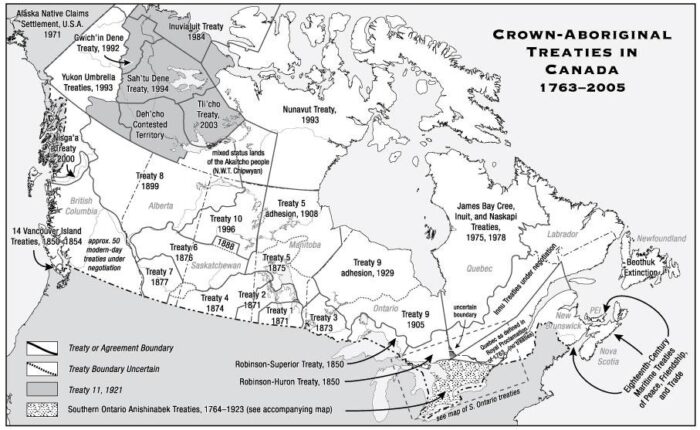
According to a Government of Canada website, “Treaties are agreements made between the Government of Canada, Indigenous groups and often provinces and territories that define ongoing rights and obligations on all sides.” A Standing Senate Committee on Aboriginal Peoples report cites an the Assembly of First Nations website stating: “Treaties are solemn agreements that set out promises, obligations, and benefits for both the Aboriginal peoples and the Crown in right of Canada.”
Historic treaties between indigenous peoples and the Crown were signed between 1701 to 1923. These differ from the modern treaties signed with indigenous peoples since the 1970s which cover matters such as land claims, resource management, and self-government. The focus for this article will be historic treaties, as these are the treaties that have pushed for the assimilation of indigenous peoples into mainstream Eurocentric Canadian society. This is unlike the Modern treaties, where assimilation was not a goal.
Why Were Treaties Signed
Treaties were signed for different reasons depending on the time period. Early treaties were signed between indigenous groups and European colonial powers to facilitate the fur trade. In addition, the French and British groups signed into military alliances with different indigenous groups to attain control of the land to fight each other. Shortly after Britain defeated the French for control of its North American colonial territories, some indigenous peoples fought alongside the British during the American War for Independence. This period of trade/military alliances lasted up to the early 1800s. After lasting peace between Britain and the United States was achieved (after the war of 1812), indigenous peoples were no longer needed for military/trade alliances, and the focus for the British moved from working with indigenous peoples to a land surrender and assimilation agenda. According to a Government of Canada website, between 1783 and 1812 fifteen land surrender treaties were established with indigenous peoples in what is now Ontario for the purposes of establishing agricultural settings for incoming settlers. In these treaties, indigenous peoples were compensated with one-time payments in goods or money or both, but only sometimes provided these peoples with reserve land. The goals of these treaties in the 19th century was to secure for settler populations from Europe fertile agricultural land or resource rich land in different parts of British-held North America while displacing indigenous peoples onto what are known as reserves. Typically, these reserve lands were less fertile and/or less resource rich.
As noted, after the military alliances were no longer needed, the British adopted an assimilation policy towards indigenous peoples.
This is described according to one account below:
“Fed by a belief in the superiority of British ideals and society, and a missionary fervour, initiatives were created to bring British “civilisation” to indigenous people throughout the British Empire. In the colonies of Upper and Lower Canada, the Indian Department became the vehicle for the expression of the new plan of “civilisation”. Based upon the belief that it was Britain’s duty to bring Christianity and agriculture to the First Nations people, Indian agents shifted their roles from solidifying military alliances towards encouraging First Nations people to abandon their traditional ways of life and to adopt a more agricultural and sedentary, more British, lifestyle.”
The Indian Department was created in 1755 by the British to manage the military relationship between colonial officials and their Indigenous allies. The assimilation policy was implemented in the 19th century by this department as a result.
After Confederation, the focus for Canada transitioned into the expansion of its western territories. This would have a significant impact on indigenous peoples living in these areas. The Crown negotiated eleven treaties (known as Numbered Treaties) between 1871 and 1921 with indigenous peoples to secure land for settlers. These treaties promised reserve lands, annuities, and the continued right to hunt and fish on unoccupied Crown lands in exchange for Aboriginal title. These treaties also pushed for an assimilation agenda that was already being enforced in central Canada with the goal to “civilize” the indigenous peoples of these territories by bringing them Christianity and teaching them agriculture or another trade. Much of this was to be accomplished in what we now call Residential Schools.
What was in these Treaties
While the goal of assimilation and expansion was the goal of treaties from a Crown viewpoint, the promises made by the Crown to indigenous peoples during treaty negotiations was very different from what was delivered.
A significant difference exists between the written conditions in the treaties and what indigenous groups say was verbally agreed to in the treaty negotiations.
An Assembly of First Nations website says the following about what indigenous groups felt they were agreeing to during the treaty negotiations (something very different from being forced away from their historical lands and onto reserves and also different from losing control of their children or being assimilated into mainstream Eurocentric Christian society – they did not want all of this):
“First Nations that signed these Numbered Treaties believed they were entering a trust relationship with the British Crown; First Nations were to share and co-exist with settlers from foreign lands. Therefore, First Nations never agreed to the sale of their lands and resources. Instead, they agreed to share their Indigenous lands, to the depth of a plough, as stated in the following quote:
“At the time, the government said that we would live together, that I am not here to take away what you have now…I am here to borrow the land…to the depth of a plough…that is how much I want.”
According to the Canadian Museum of Human Rights website:
“From the perspective of Indigenous nations, treaties were supposed to establish peace, friendship and respectful sharing of the land. The state had different intentions. It took a colonizing approach to negotiating and interpreting these agreements. This led to oppression, loss and enduring harm. Nonetheless, treaties fundamentally defined the relationship between Indigenous nations and Canada. They remain important to this day.”
The Canadian Museum of Human Rights website also addresses what indigenous peoples thought about the treaties they signed. Consider Treaty 3, in which the following was said:
“Elder Robert Greene, whose father was former Grand Chief of Treaty 3, notes the Chiefs saw treaty negotiations as allowing Crown representatives safe passage through their territory, rather than a surrender of lands.”
Indeed, the European concept of ownership of the land was very different from the view of indigenous peoples, who viewed their relationship with the land as a sacred connection instead of something that could be bought or sold. From this perspective, land is viewed as something that gives and sustains life instead of something that could be bought or traded away.
Indigenous peoples also signed these treaties due to the challenges they faced during this time period. This included the following:
– A desire to survive in the face of disease (with treaties assuring the greater availability of medicine)
– Disruptions to traditional ways of life (eg. loss of bison that indigenous populations depended upon – these animals were killed by settlers)
– Needing assistance in taking up agricultural activities
– Protection from American expansion
– Differing understandings of treaty agreements (as noted above) – Treaties were often oral agreements from an Indigenous worldview, while the written documents could have different interpretations and implications not understood by indigenous peoples – certain words in the English or French language did not exist in indigenous languages and vice versa
What was the Impact of Treaties and a Way Forward
Indigenous peoples often say that what was agreed to in treaties was very different from what was delivered – Broken promises.
What was promised by the Crown was that Canada would respect and protect the Indigenous nations. Instead of this, indigenous peoples received dispossession, destruction, and confinement on reserves. Treaties empowered the Crown to remove children from their homes and communities, punished them for speaking their language, set up a system which prevented them from practicing their cultural traditions, and deprived them of their traditional lands, food, and water.
As a way forward, consider the line from the Canadian Museum of Human Rights:
“Indigenous people and settlers can make our way together if we return to the original goals of meeting nation‐to‐nation in treaty: be kind to one another, walk with one another and love each other and the land we share.”
