Circular Economy Sustainability Actions In Schools
Think about all the garbage we produce here in Canada. From single-use plastics to diapers to packaging materials to textiles and so much more we need a good alternative to throwing waste in a landfill. All this waste contributes to climate change, biodiversity loss, and the need to extract lots of resources adversely impacting our environment and economy. The Circular Economy (CE) approach is a comprehensive strategy to eliminate waste and make maximum use of all resources through continuous reuse. With the CE approach – according to one definition – “instead of industries, manufacturers and consumers taking resources, using them once and disposing of them, they will be kept in use. Products will be designed to be more durable, reusable, repairable and recyclable, and businesses will look for ways to eliminate waste in their operations.” As such, it’s an approach that eliminates waste when making, using, and disposing of anything
To promote this approach, I am currently working with schools and teachers in the Toronto area and beyond to incorporate CE education and action as part of regular classwork or environment group activities (eg. Eco Teams or Eco Club initiatives). Over the last several years, I have been working with students between grades 4 and 12 to adopt CE methods. I first present the details of the CE concept to students and then have students apply these strategies in their school setting. The work I do includes describing the CE approach to students, guiding students in implementing CE practices in their school setting, reviewing the results of these CE projects and providing feedback, preparing CE curriculum materials, and working with teachers to deliver CE concepts to students. Examples of projects that students have executed with my assistance include repairing items, organizing a swap event, promoting waste reduction through school publications, collecting used textiles from students for donation purposes, collecting used books to donate to libraries, repurposing textile waste, and many other CE projects. My goal is to reach as many schools as possible to ensure that students are aware of the problems and solutions associated with waste and to encourage them to take action in their school setting and beyond. Reaching students is also a way of reaching out to their parents and the broader community.
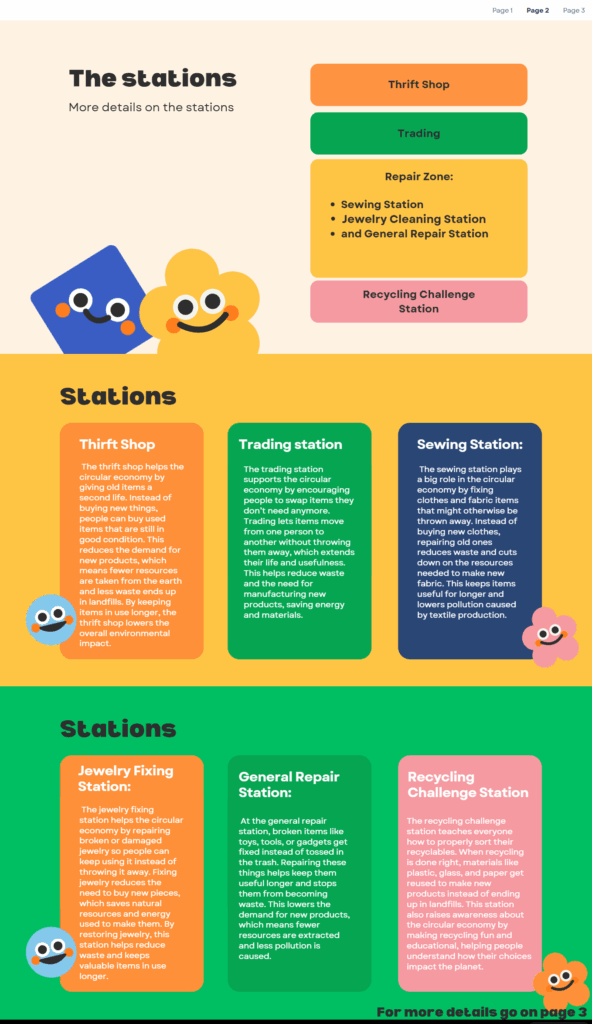
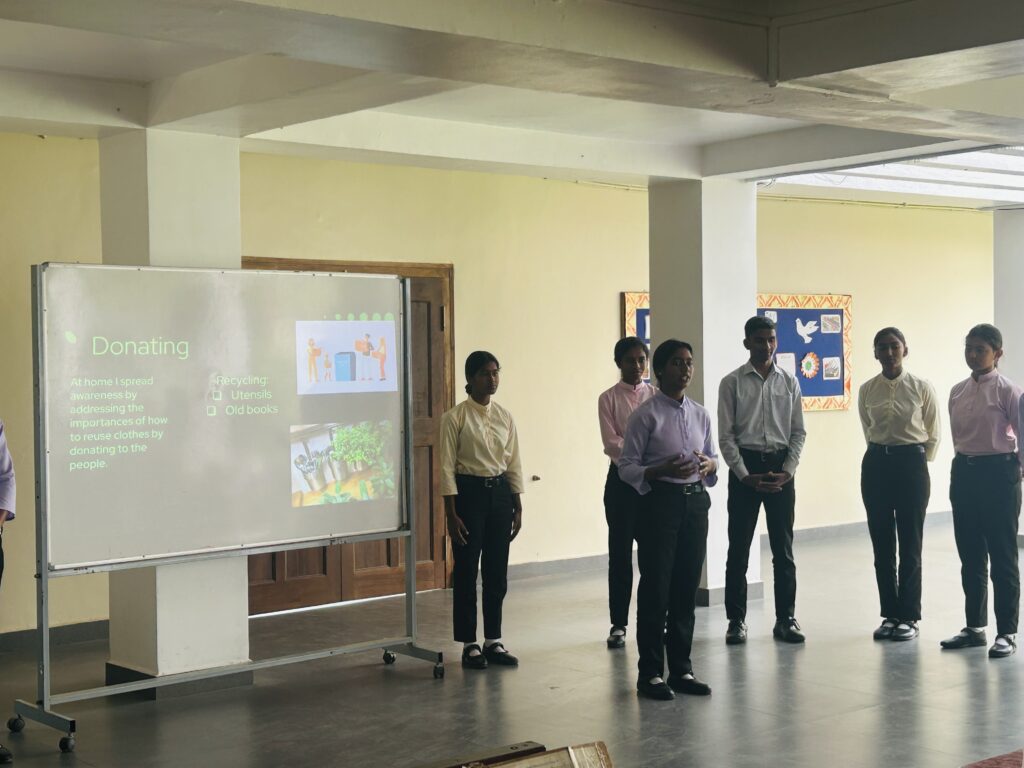
Here are some pictures of the work (actual picture or representational image with a description) performed by the students at schools that I worked with – there are many other projects in addition to the ones illustrated/described below.



If you know of any schools or teachers who might be interested in incorporating Circular Economy ideas and student action via project work into their classrooms please contact me via the Contact Form on this website.
Background:
Circular Economy Methods and the UN’s Sustainable Development Goals
The Circular Economy (CE) approach maximizes resource use efficiency without any waste and without releasing toxins into the natural environment. When something does get released into the natural environment it is done in a way that makes nature better instead of making it worse.
A definition of the CE approach (from the Ellen MacArthur Foundation) is provided below:
“The circular economy is a system where materials never become waste and nature
is regenerated. In a circular economy, products and materials are kept in
circulation through processes like maintenance, reuse, refurbishment,
remanufacture, recycling, and composting. The circular economy tackles climate
change and other global challenges, like biodiversity loss, waste, and
pollution, by decoupling economic activity from the consumption of finite
resources.”
This document outlines how CE methods are linked to different UN Sustainable Development Goals (SDGs). It then provides information on our CE high school competition to implement CE methods in a school setting.
Circular Economy and the Sustainable Development Goals
Relevant SDGs are stated alongside an example of how CE methods are linked to this goal.
Goal 1: No Poverty – CE methods can provide employment to those who lack education and skills – for example, waste collectors who collect waste on streets so that this waste can be upcycled into products that can be sold. This can provide employment to those who would otherwise live in poverty.
Goal 2: Zero Hunger – According to the World Food Programme “nearly a third of all food produced each year is squandered or lost before it can be consumed.” Food waste happens at all stages of the food supply chain from farms to households and collecting waste at each stage that would otherwise be thrown away is a goal of many CE practitioners. CE practitioners reduce food waste by redistributing food that would otherwise be wasted to organizations that help those who do not have enough food to eat.
Goal 3: Good Health and Well-Being – The CE approach requires that toxins are not released into the environment. This can help in reducing human illnesses that are caused by these pollutants. For example, the CE approach supports regenerative agriculture – an approach that reduces the reliance on chemical fertilizers and pesticides that are sources of water pollution. CE requires that we do not pollute the environment.
Goal 4: Quality Education – education in CE methods can assist in developing a sustainable lifestyle.
Goal 6: Clean Water and Sanitation – Some CE practitioners perform the collection, treatment, and transformation of human sludge and waste. This sludge and waste can be transformed into fertilizer to grow crops and fuel to power machines.
Goal 7: Affordable and Clean Energy – CE practitioners advocate for renewable energy sources as these sources of energy do not release climate change pollution or other sources of air pollution into the environment.
Goal 8: Decent Work and Economy Growth – CE methods include the Sharing Economy approach. An example of a Sharing Economy approach is ridesharing with companies such as Uber or Lyft. These companies promote the sharing of cars and provide jobs for drivers. Other Sharing Economy companies also provide good employment opportunities. These companies allow people to share what they possess such as their skills, accommodations, food, and office space.
Goal 9: Industry, Innovation, and Infrastructure – some CE practitioners have devised methods to reuse and recycle construction and demolition material waste to build new buildings. Other CE practitioners improve industrial processes making processes that require less energy and water as well as produce less waste. This can reduce costs and be better for the environment.
Goal 11: Sustainable Cities and Communities – CE methods improve waste management processes by reducing waste. This reduces the need for cities to have large landfill space. Instead of throwing products into landfill CE methods turn these products into something useful for others. This is done through methods such as donating used products (ie. reuse) or taking the working parts of a used product to make new products (ie. remanufacture)
Goal 12: Responsible Consumption and Production – CE methods promote maximum resource efficiency meaning that products and materials within products are used in the best possible way. For example, CE methods promote repairing items when they are broken instead of throwing them away. Consider repairing your cell phone instead of getting a new cell phone. Many jobs can be creating by making it easy to repair electronics and other devices. Repairing items is responsible consumption while making it easy to repair items is responsible production.
Goal 13: Climate Action – According to the UN Environmental Program (UNEP) “resource extraction and processing account for over 60 per cent of planet-warming emissions”. Circular Economy methods reduce resource extraction and processing since we make maximum use of the resources already being used. This is done through methods such as sharing, repairing, reusing, and recycling as well as the production of compost and fertilizer to grow crops.
Goal 14: Life Below Water – CE methods promote reduced pollution. This includes plastics which in many cases end up in our oceans. According to the organization Ocean Conservancy, every year 11 million tonnes of plastic pollution ends up in our oceans. Plastic pollution harms species living in waters as many species die after getting entangled or ingesting plastics. CE methods aim to minimize ocean plastic pollution by reducing single use plastics, creating biodegradable plastics, reusing existing plastic materials instead of throwing them away, and better recycling methods for plastics so that new plastics do not have to be created as much.
Goal 15: Life on Land – CE methods promote biodiversity-friendly practices which add to nature instead of taking away from it. An example of land-based methods for this are biodiversity-friendly agriculture practices such as cover cropping, agroforestry, and crop rotation that naturally ensures healthy soils to grow crops. This contrasts with farming practices that make use of chemical fertilizers and pesticides that harm biodiversity.
Competition Details
In the future I plan to create a Circular Economy competition for students – some of the details can be found below – please contact me if you are interested in participating in a Circular Economy competition.
The goal of this High School Circular Economy competition is to have students thinking about how to apply Circular Economy concepts in the real world. Each group of students will be asked to come up with a Circular Economy idea and implement this idea over the course of several months. An initial application form must be submitted by each group which will be followed by a self-evaluation form and a group submission form. A teacher contact for each group will also need to submit a short evaluation form of the project. Judges might opt to meet the students to further evaluate their submission.
The competition forms are below:
Eligibility Form – this form states the rules of the competition including dates and submission requirements.
Application Form – this form asks the students to provide some information about themselves and details on the type of Circular Economy activity they wish to pursue.
Group Reflection Evaluation Form – this form asks the group to evaluate their own submission after it is complete.
Project Submission Form – this form asks the group to provide details on the results of their Circular Economy project. This is so that judges can evaluate whether the project was a success and if so the degree to which it was a success from a Circular Economy perspective.
Teacher Submission Form – this form asks the teacher contact for each group to judge the project submission.
